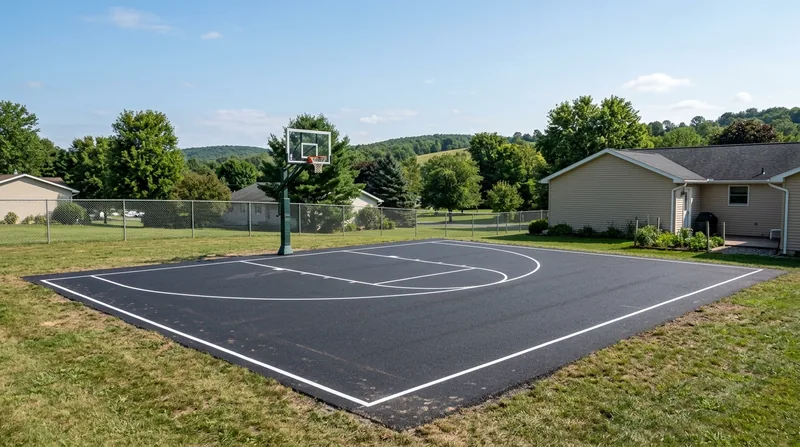




Sports Court & Path Paving in Utica sits on ground that moves. Utica's post-war neighborhoods and newer subdivisions spread across valley floor and rolling upland terrain where the frost line runs deep, close to 42 inches, and every winter heaves an unprotected slab. A tennis court, basketball court, or walking path built on shallow fill or poor drainage will crack and fail in three to five years. Building a court here means digging past the topsoil into the glacial till, laying a compacted aggregate base thick enough to shed water and resist frost, and capping it with hot mix asphalt. That foundation is what separates a court that plays flat for a decade from one that's cracked and unsafe by spring. We've been building courts and paths in Utica and across Oneida County since 2013, and we know what the ground demands.
Why Sports Court & Path Paving Matters in Utica's Freeze-Thaw Climate
Utica's winters are the reason. The city sits at the bottom of the Mohawk Valley with a deep frost line and a long freeze-thaw cycle that moves earth and breaks concrete. A court or path built on a shallow base or compacted poorly will heave in January, settle in March, and crack by April. The base is everything. We excavate deeper than most contractors, compact the fill in six-inch lifts with a vibratory compactor, and proof-roll the finished base before we lay any asphalt. That takes time and equipment, but it stops the failure before it starts.
- We excavate below the frost line to remove topsoil and poor-draining material that holds winter water.
- We compact aggregate base in controlled lifts to achieve density that resists heave and settlement.
- We proof-roll the finished base to find soft spots before asphalt goes down.
- We lay hot mix asphalt at the thickness required for court play and foot traffic, typically 2.5 to 3 inches.
- We slope the court for drainage so water runs off and does not pool at the edges or corners.
A properly built court in Utica stays playable through the upstate winter and holds its surface for ten to fifteen years.
Key info: The City of Utica and surrounding towns like New Hartford, Whitesboro, and Rome all require permits for new hardscaping and impervious surface. Check with your local building department before we break ground. We help you navigate the paperwork, but the permit is your responsibility and the town's authority.
For detailed permit requirements in your jurisdiction, contact the City of Utica Building Department or your village clerk. Permitting rules vary across Greater Utica, and HOA architectural standards may also apply if you live in a master-planned community.
How We Build a Court or Path in Utica: Step by Step
Every court project starts with a site visit and a measurement. We look at drainage, slope, soil condition, and access for equipment. We write a specification that names the depth of excavation, the aggregate base type and thickness, and the asphalt tonnage required. No guessing, no "we'll figure it out as we go." Then we excavate, compact, pave, and finish to that spec.
- We mark out the court or path boundary and call New York 811 for a utility locate before we dig.
- We excavate the area to the depth required by soil condition and frost line, typically 18 to 24 inches for a court.
- We haul off the spoil and bring in clean crushed stone or recycled asphalt base material.
- We spread the base in lifts, compact each lift with a vibratory plate or roller, and proof-roll the finished base.
- We set up the asphalt paver and lay hot mix at the specified thickness, typically 2.5 to 3 inches for a court.
- We roll the asphalt while it is hot to achieve the required density and a smooth, even surface.
- We finish the edges with a hand trowel and let the court cure before it is opened to play.
A court in Utica typically takes three to five working days from excavation to finish, depending on size and weather.
Local example: We built a half-court in Yorkville on a hillside lot where the ground sloped steeply to the south. We cut the slope back, built a 20-inch aggregate base, and pitched the court to drain to the downhill edge. The court has been flat and playable for nine years. The homeowner told us that every other contractor he called said the slope was too steep and walked away.
If you have a sloped lot or drainage concerns, that is exactly what we solve. Call us for a free site visit and estimate.
Sports Court & Path Paving Methods and Materials
| Approach | Description | Best For |
|---|---|---|
| Full Excavation and New Build | We remove topsoil and poor material, compact a thick aggregate base, and lay new asphalt on a prepared subgrade. | New courts or paths on raw ground, sloped terrain, or areas with poor drainage. |
| Overlay on Existing Base | If an old court has a sound base but a worn surface, we mill the top layer and lay new asphalt over it. | Resurfacing a court that is still structurally sound but cracked or rutted on top. |
| Recycled Asphalt Base | We use recycled asphalt millings or reclaimed asphalt pavement as base material, compacted and proof-rolled. | Cost-conscious projects where the subgrade is stable and a recycled base meets local code. |
| Grading and Drainage Setup | We grade the site to slope toward drain points, install or clear swales, and compact fill to ensure water runs off. | Courts on sloped or wet ground where drainage is the primary concern before paving. |
Sports Court & Path Paving Cost in Utica: What to Expect
A small court or path in Utica starts around $8,500 to $12,000. That covers excavation, a compacted aggregate base, and 2.5 to 3 inches of hot mix asphalt on a space roughly 1,500 to 2,000 square feet. Larger courts, sloped terrain, poor drainage, or deep excavation will move the cost up. We write a specification with tonnage and depth so you know exactly what you are paying for, not a vague per-square-foot number that changes when we dig.
The biggest factors that affect cost are size, soil condition, how much excavation is needed, and whether the site drains well. A court on flat, well-drained ground costs less than one on a slope or in a wet spot. Access for equipment matters too. If we have to carry material by hand or stage equipment on a narrow lot, labor and time go up.
Always get two or three estimates in writing, with specifications. A real estimate names the depth of base, the type of asphalt, and the tonnage. If a contractor gives you a price per square foot without seeing the site, that is a red flag. See our full pricing overview for typical ranges across our service area, and call us at (315) 927-1890 for a free estimate. We respond within 24 hours and do not charge for the visit.
Sports Court & Path Paving Near Me: What Utica Homeowners Should Know When Hiring
Hiring a paving contractor is a major decision, and the ground matters more than the price. A court or path is only as good as its base, and a low bid from someone who does not understand Utica's frost line and drainage is money wasted. Here is what to verify before you sign a contract.
- Ask for a written estimate that includes excavation depth, base material type and thickness, asphalt thickness, and tonnage.
- Verify that the contractor is fully insured and ask for a certificate of insurance naming your property.
- Check references from local jobs in Utica, New Hartford, or nearby towns where the ground is similar.
- Ask about the contractor's experience with sloped terrain and drainage, which are critical in our climate.
- Confirm that the contractor will obtain or help you obtain any permits required by your municipality or HOA.
- Do not sign a contract that requires a large cash deposit upfront or does not include a warranty on workmanship.
Licensing for paving is set by the city, not the state. The City of Utica does not require a specific paving license, but other municipalities in our service area may. Check with your building department to see what is required in your jurisdiction. We hold full insurance coverage and are happy to provide a certificate of insurance before we start work.
Avoid contractors who show up unsolicited at your door, offer a price without visiting the site, demand cash, or claim to have leftover asphalt from a job nearby. That is the classic door-to-door paving pitch, and it is how homeowners get defrauded. Any contractor worth hiring will visit your site, measure it, look at the soil and drainage, and write a specification before quoting a price. We work that way, and we are happy to answer your questions before you decide.
Sports Court & Path Paving in Utica: Pricing Guide
| Service | Price | Details |
|---|---|---|
| Small court or path (1,500 to 2,000 sq ft) | Starting at $8,500 | Excavation, compacted aggregate base, 2.5 inch asphalt, drainage grading included |
| Medium court (2,000 to 3,000 sq ft) | Starting at $12,000 | Larger footprint, deeper base on sloped or wet ground, full drainage solution |
| Large court or complex site | On estimate | Sloped terrain, poor drainage, extensive excavation, or utility conflicts require site visit first |
| Travel and site visit | Included | No mileage fee or call-out charge in Utica and surrounding Oneida County service areas |
| Written estimate | Free | Includes excavation depth, base spec, asphalt tonnage, and 24-hour response time, no obligation to book |
Indicative pricing, the exact cost depends on square footage, finish, and site access. Free personalized estimate within 24h at (315) 927-1890.


